Good afternoon. Welcome to the AA0RC Repeater. The time is 3:33 p.m.
The automated greeting crackles through the radio on Dan “WZ9W” Schnaare’s desk in response to a call sent …
This item is available in full to subscribers.
We have recently launched a new and improved website. To continue reading, you will need to either log into your subscriber account, or purchase a new subscription.
If you are a digital subscriber with an active subscription, or you are a print subscriber who had access to our previous website, then you already have an account here. Just reset your password if you have not yet logged in to your account on this new site.
If you are a current print subscriber and did not have a user account on our previous website, you can set up a free website account by clicking here.
Otherwise, click here to view your options for subscribing.
Please log in to continue |


Good afternoon. Welcome to the AA0RC Repeater. The time is 3:33 p.m.
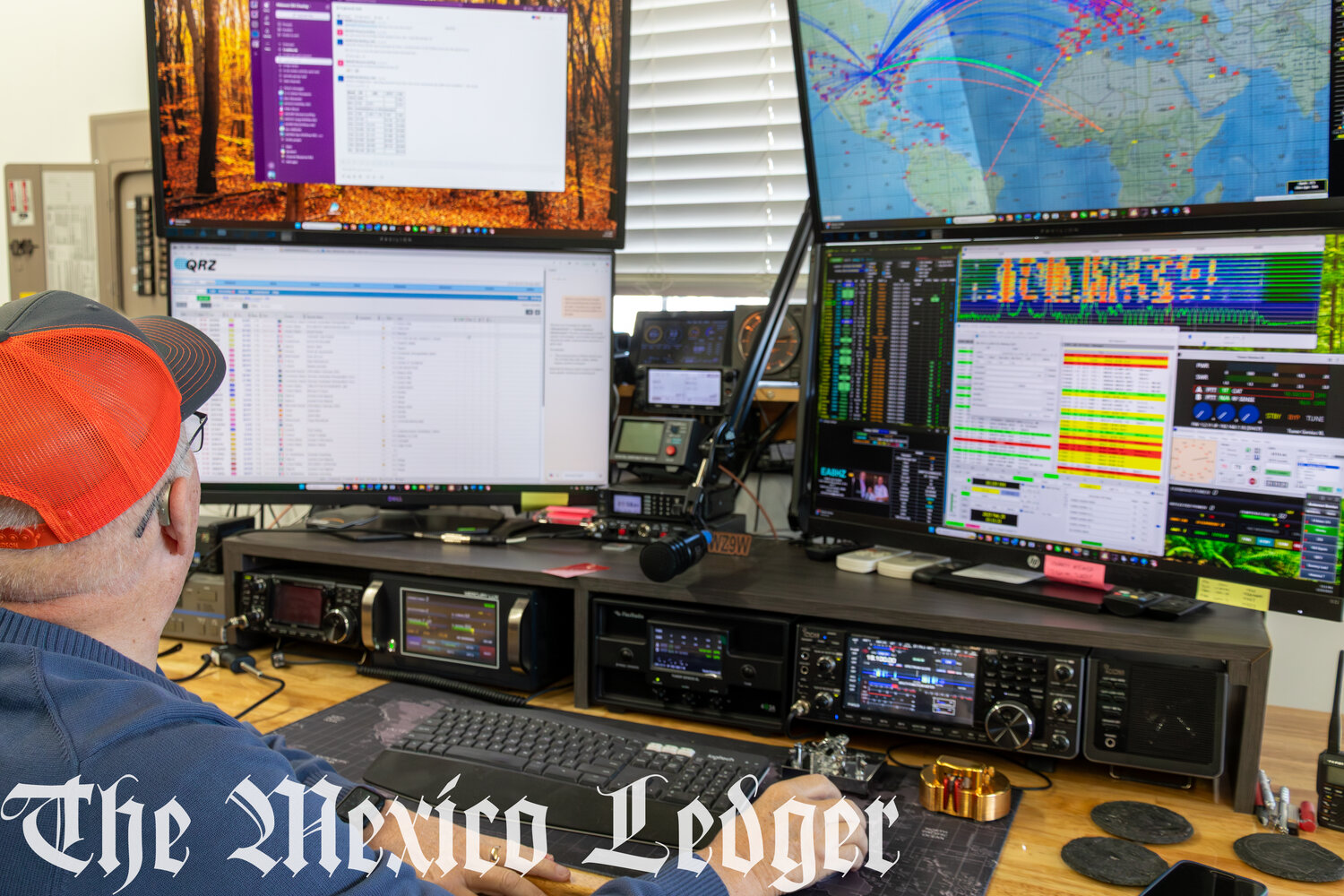
The automated greeting crackles through the radio on Dan “WZ9W” Schnaare’s desk in response to a call sent by Rick “KF0JCP” Smith from a handheld radio just outside of Schnaare’s Ham Shack in Centralia. The signal traveled about 20 miles to the Radio Repeater in Mexico, before being sent back.
“KF0JCP, WZ9W,” Schnaare confirms.
Schnaare and Smith are members of Audrain Emergency Communications Inc. serving as vice president and treasurer, respectively.
AECI is a 501(c)(3) nonprofit organization consisting of 30 amateur radio operators who meet monthly at the Help Center in Mexico. They are dedicated to their craft, teaching and practicing nearly every day.
The goal of AECI is to keep the industry alive as much as it is to be prepared for an emergency situation.
The early beginnings of ham radio
Ameteur radio communication began in December 1901 when Italian engineer Guglielmo Marconi first transmitted wireless signals across the Atlantic with a radio device. He successfully sent wireless waves 2,100 miles between Poldhu, Cornwall and St. John’s, Newfoundland, in order to prove that the waves were not affected by the curvature of the earth.
Marconi patented his “magnetic detector” that would become the standard wireless receiver in 1902. In December 1902, Marconi was able to transmit the first complete message to Poldhu from Glace Bay, Nova Scotia, and later from Cape Cod, Massachusetts.
Since then, the radio communications industry has exploded. With applications beyond military and commercial use, its popularity spread before regulations could be put in place. The growing number of radio operators causing interference on radio systems followed by the sinking of the Titanic prompted an investigation which led to the establishment of the Radio Act of 1912.
The Radio Act of 1912 was the first federal regulation for radio. It required all broadcasters be licensed and limited radio operations to specific wavelengths.
Marconi, aptly named “the father of radio,” received several honorary doctorates from multiple universities and a number of other awards and honors, including the Nobel Prize for Physics, which he shared with Professor Karl Braun, in 1909.
Amateur radio is often called ham radio. They mean the same thing regarding the noncommercial or personal use of specific radio frequencies.
The word “ham” has numerous debatable origins. Some believe the word was professional telegraphers’ nickname for the clumsy, “ham-fisted” radio operators who were inexperienced in Morse Code.
Others believe the term was simply used as a shorthand to distinguish amateur and professional radio operators.
Amateur radio in Audrain County
The AECI leaned on the memories of its most senior members and records kept by fellow ham radio operators to nail down the most complete history of their club.
Dick “K2HT” Thompson is 82-years-old. From a young age, Thompson had an interest in radio operation so strong, it led him to seek out radio operators in Centralia and Mexico.
World War II veteran Jim “K0EZB” Curtis had been a CW radio operator during his time in the military. He and aircraft operator Charles “K0HNE” Anderson were regarded as “great CW operators” who liked to teach and encourage young radio enthusiasts such as Thompson.
Thompson, Curtis and Anderson met regularly with another zealous operator, Marty “N5MCA” Admire, in an old school building near the Mexico Memorial Airport.
Their club, dubbed the Audrain Amateur Radio Club, grew to include a great deal of local business owners and public figures including former Postmaster Charles “W0MRQ” Ayers, Chief Radio Officer for the Panhandle Eastern Pipeline Co. Monroe “W9KF” Penick, metallurgist Howard “K0ACK” Gibbins, former Best Western – Mexico owner Bob “WZ0EST” Stephenson and former Circulation Manager of The Mexico Ledger Vernon “K0ELB” Duffy.
The AARC continued to push the boundaries of radio and in 1977 the idea of installing a two-meter repeater came about.
Despite pushback from members who were unsure about this relatively new technology that used line-of-sight transmission as opposed to the high frequency waves they were used to, the first radio repeater was built, tested and fixed to a Cable TV system donated by former Mexico Ledger owner Bob White later that year.
The success of the repeater that once divided the club eventually brought them back together.
Now, the AECI has five radio repeaters and with an antenna at 900 feet, they cover approximately an 80-mile radius.
The newest repeater made by the AECI uses a Motorola commercial repeater.
“It was probably made for the police department, fire department or something like that and this radio was retuned to the amateur radio band,” said Schnaare. “We put all the pieces together and got it working.”
The Wizard of Ham Radio
Schnaare is from Campbell Hill, Illinois. His introduction to ham radio was completely by chance, when his wife’s uncle invited him to a ham radio class happening about 40 minutes away in Carbondale when he was 23.
“When I tested as a novice, my only form of communication was with Morse code or CW,” Schnaare remembers. “It’s not like that anymore because they’ve done away with the requirement.”
Schnaare gave up his license and put his ham radio hobby on hold when his career at Spartan, which is what brought him to Mexico, took off.
He started at the company sweeping floors in the early 80s.
“I took some classes in industrial electricity, industrial electronics and machinist, so I knew just enough to be dangerous,” said Schnaare.
He may not have had a degree, but he did have a notebook and a knack for figuring things out.
Soon, Schnaare’s unique ability to understand and fix the machinery and his immaculate note-taking allowed him to rise through the ranks, eventually being transferred to Mexico to start up the new facility.
“I’ll dig into anything and figure it out,” said Schnaare. “If I want to learn something, I sit down for days until I figure it out.”
Schnaare has been a member of AECI since getting back into the hobby four years ago
“The first year, I stayed pretty quiet to get to know who the people were and then the second year I became more active and vocal and provided my ideas and thoughts,” said Schnaare, who quickly became vice president and a board member.
Schnaare is working with four radios that operate from 440 mhz down to 1.8 mhz.
Even to experienced ham radio operators, Schnaare’s set-up is quite advanced and very high tech.
“You can be as simple as you want in this stuff, or you can nerd this thing out to the hilltop,” Smith jokes.
“This is a nerd example,” Schnaare said, beaming.
That combined with his wealth of knowledge and affinity for problem-solving has earned him the nickname “the wizard” in the world of ham radio.
The scope of AECI today
AECI has been registered since 2008 and has been awarded grants through the AP Green Foundation and has been supported through sponsorships from local businesses such as the KWWR Radio Station.
KWWR has donated a spot on their tower at 900 feet for an AECI antenna. Radio tower real estate is worth thousands of dollars a year for companies who lease the space, but with its 501(c)(3) designation, the AECI uses it for free.
“If it wasn’t for the businesses in Mexico that helped us out in the early days, we wouldn’t be where we are today,” said Schnaare.
The AECI continues to hone their craft, sharpening their skills for more than just pleasure. In emergency situations and natural disasters such as tornadoes, it is possible that radio will be the only available form of communication.
Schnaare experienced this first hand in the 80s when a tornado devastated Marion.
“At that time, the amateur radio group went over to help the Red Cross, not in any of the rescue, but trying to find family members,” said Schnaare. “I was the guy who manned the radio station at the church.”
Many AECI members are also trained weather spotters working closely with the National Weather Service in St. Louis.
In 2017, the AECI used some of their grant money to purchase the Emergency Communications Trailer which has a fully functional 65’ pneumatic mast to raise their antenna. Even in the event that all communications, including local radio towers, are wiped out, that trailer is equipped with a radio repeater, which can have the AECI on the air immediately.
“We hope the area will never have a need for us; however, we are constantly building out infrastructure should it be needed,” said Schnaare.


